Justice, Peace, Integrity
of Creation
Justice, Peace, Integrity
of Creation
By John Paul Pezzi, Mccj
Justice, Peace, Integrity
of Creation
By John Paul Pezzi, Mccj
Justice, Peace, Integrity
of Creation
By John Paul Pezzi, Mccj
Justice, Peace, Integrity
of Creation
By John Paul Pezzi, Mccj
In Congo, the Ebola epidemic is spreading into refugee camps
Il Post 31.07.2026 Gradel Muyisa Mumbere Translated by: Jpic-jp.orgExtremely poor sanitary conditions and overcrowding are fuelling transmission, but the population is facing even more pressing problems.
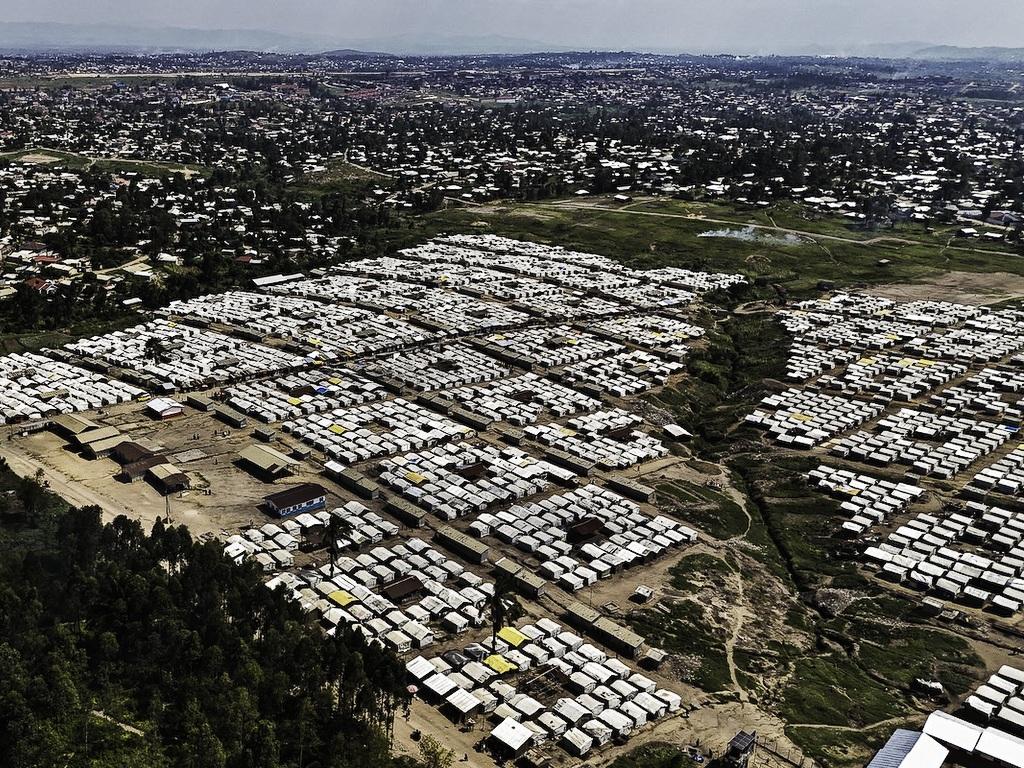
Seen from above, the Kigonze refugee camp in the north-east of the Democratic Republic of the Congo looks like a vast expanse of white rectangles, neatly arranged in rows and columns to form a diamond-shaped area of about 0.2 square kilometres — roughly half the size of Vatican City. The rectangles are tents housing around 20,000 people displaced by violence between rival ethnic militias that has persisted for decades in the border region with Uganda, Rwanda and Burundi.
Kigonze is in Ituri province, the area hardest hit by the recent Ebola epidemic. Just over two months after the first cases were reported, more than 1,500 people have died out of almost 3,500 infected [the latest report puts the figures at 3,000 deaths and 7,000 infections]. It has become the second-worst Ebola epidemic on record, after the outbreak that swept through West Africa between 2014 and 2016, when 11,000 people died (these are official figures and are almost certainly an underestimate). Deaths and infections are increasing far more rapidly than in previous Ebola epidemics: during the 2014 outbreak, it took eight months to reach 1,000 deaths.
The virus spreads easily in refugee camps, where the dire humanitarian situation is also worsening public health conditions. At Kigonze, 55 people died between the beginning of April and the end of June — more than 18 deaths a month, compared with an average of two during previous periods. At least four of these deaths were confirmed to be linked to Ebola, but many families refused to undergo testing because of a lack of trust in the authorities.
Ebola is an infectious disease with a high fatality rate among those who contract it. It is caused by a group of viruses first discovered in the second half of the 1970s. For many years, the best-known and most widespread species was Zaire ebolavirus. The current epidemic, however, is being caused by Bundibugyo ebolavirus, first identified about 20 years ago in Uganda.
Because it has historically been relatively uncommon, it has been less extensively studied, meaning there are fewer tools available to contain its spread. There are, for example, no approved vaccines or treatments, although clinical trials are under way. For now, the only way to contain it is to identify patients quickly, isolate them and provide treatment.
Trish Newport, deputy head of Ebola management in Congo for Médecins Sans Frontières (MSF), says health workers are “chasing the epidemic rather than staying ahead of it”, as resources are being consumed by large outbreaks where hundreds of cases have already been recorded, preventing timely intervention when the first warning signs appear in new areas.
The structure of the refugee camps does not help. Rachel Criswell, head of external relations for the United Nations Refugee Agency (UNHCR) in Kinshasa, the capital of the Democratic Republic of the Congo, says that while rural life in Congo is traditionally dispersed among isolated farms, the camps resemble huge, densely populated “apartment blocks”, making it easier for diseases to spread. At Kigonze, there are around 100,000 people per square kilometre. By comparison, Dhaka, the capital of Bangladesh and one of the most densely populated cities in the world, has just under 50,000 inhabitants per square kilometre.
Sanitary conditions in the camps are described by aid workers as “disastrous”. Kigonze is still short of 580 latrines needed to meet minimum international standards. Diarrhoea is one of the main routes through which the Ebola virus can spread, and the lack of adequate latrines makes it almost impossible to halt the epidemic. In the Tsere camp, which, like Kigonze, is in Ituri, more than 6,400 people share a single water reservoir, while latrine maintenance is inadequate. Newport says that in some areas, the water supply has fallen to 2.5 litres per person per day, below every recognised humanitarian standard. The lack of soap, taps and clean water makes the medical recommendation to wash regularly in order to prevent infection difficult to follow.
There is also widespread mistrust of the healthcare system among the population. This is evident in opposition to protocols that prevent traditional funeral rituals, such as washing the body, which in the case of Ebola carries a high risk of transmission. Families often bury relatives who have died secretly to prevent health workers from taking away the bodies. In recent months, this resistance has turned violent: dozens of attacks have targeted medical facilities and ambulances, involving stone-throwing and threats. In some cases, medical staff have been forced to travel in vehicles with tinted windows to avoid being identified and attacked.
Even before the Ebola epidemic, the Democratic Republic of the Congo was already grappling with one of the world's most serious humanitarian crises. More than five million people are displaced across the country, including 1.3 million in Ituri province alone, as a result of conflicts involving various non-state armed groups. Displaced people are forced to abandon their homes and flee fighting for areas considered safer, even when this means moving towards Ebola hotspots and undermining efforts to monitor the spread of the disease.
In general, Ebola is not the main concern for a large part of the population, and the health crisis is colliding with other basic needs. Many displaced people, for example, work as day labourers and cannot afford to remain in quarantine for long periods because that means losing their income and being unable to bring food home. It is common for people to move in and out of the camps to work, unintentionally spreading the virus. Newport says mothers ask for water and treatment for malaria, a disease transmitted by the bites of certain mosquitoes, which for the time being kills far more people than Ebola: “We cannot respond only to Ebola when people have no water; Ebola is not their priority. Having basic medicines is.”
The situation is being made worse by cuts to international aid funding. In 2025, UNHCR announced a global 30 per cent reduction in its staff costs because of declining donations from many states, while in the Democratic Republic of the Congo, funding for sanitation services was halved between 2024 and 2025. Even when funding has been pledged, things do not always go according to plan. “The money has to actually reach the bank accounts to make sure we can continue buying soap and fuel,” Criswell says. “There is definitely a delay between the announcement of funding and the moment when those funds are actually visible on the ground.”
Despite the dramatic situation, there are also examples of effective local action. Newport cited two refugee camps in Ituri where community leaders have taken responsibility for monitoring infections, independently screening new arrivals to identify people coming from high-risk areas, monitoring contacts of suspected patients and taking them to isolation centres as soon as symptoms appear. In addition, the Congolese government has made healthcare free of charge in the four worst-affected areas. This encourages mothers to take their children to hospital, allowing for early diagnoses that are essential in distinguishing between malaria and Ebola.
See: In Congo l’epidemia di ebola si diffonde anche nei campi profughi
Photo: Kigonze refugee camp, Democratic Republic of the Congo, 18 June 2026 — © REUTERS/Gradel Muyisa Mumbere
Info
Email: jampypezzi@gmail.com - tel. +39 328 732 6990 / +243 991 457 856
This blog is made in 4 languages: it en fr es

 EDitt | Web Agency
Leave a comment