Justice, Peace, Integrity
of Creation
Justice, Peace, Integrity
of Creation
By John Paul Pezzi, Mccj
Justice, Peace, Integrity
of Creation
By John Paul Pezzi, Mccj
Justice, Peace, Integrity
of Creation
By John Paul Pezzi, Mccj
Justice, Peace, Integrity
of Creation
By John Paul Pezzi, Mccj
Neither Sects nor Ideologies, but the Patience to Desire
Butembo 01.01.2026 Jpic-jp.org Translated by: Jpic-jp.orgAndrés Trapiello (León, Spain, 1953) recounts that he has had tremendous luck in life: “I have been thrown out of every place I should have left anyway.” This opening line of an interview, oscillating between irony and scepticism, was published in Ethic. When asked, “In secular societies, have ideologies become the modern religions?” he responds with clear disillusionment: “I wouldn’t even give them the status of a religion. Ideologies are the new sects. Las ideologías son las nuevas sectas.”

According to Trapiello, these sects have “wrapped themselves in a kind of ideological packaging,” which is nothing more than “a feeling, an impulse, an intuition. Religions respond to the ineffable, to eternity, to human finitude; these ideologies resemble that, but aim at a kind of paradise on Earth, pursued through various causes — politics, ecology, feminism, Gaza — constantly shifting so as not to break the essence of the sect: the cohesion among its members. Belonging to a group gives them strength.”
A quick look online — via Google, ChatGPT, or Google Gemini — confirms the truth of this: ideologies function like sects, not founded on science or the pursuit of truth, but on belonging to.
Trapiello adds: “Cultural hegemony makes many left-wing people culturally supremacist. A left-wing person believes that, by being left-wing, they love culture more and have read more.” Yet this cultural hegemony, left or right, is ultimately just belonging to an ideological sect. The result is that, when discussing Gaza-Israel or anti-fascism versus Islamophobia, the notion of “belonging to” can overshadow reality and suffocate understanding.
In this newsletter edition, at the start of the year, we step away from the usual format. At the risk of presenting a somewhat disorderly mix, we report on diverse opinions on pressing issues, without implying agreement. Humbly, and without economic or political backing, we emphasise what sustains us: not a belonging to but hope — what Paola Mastrocola calls La pazienza del desiderio — the endurance to desire. Her reflections focus on youth, yet illuminate a path for life as a whole, including public life. In a world that desperately needs it, we adapt her message: hope in waiting.
Hope is Desire
Hope is belief and trust that what we desire will come to pass. Desire comes from de sidera, “under the stars,” feeling their distance, suffering their remoteness. Augurs once used this term: without stars, they could neither see nor predict the future. Hope is therefore primarily a contemplative, inward gesture. In the darkness of night, gazing at the stars, one finds the confidence that what we lack — what we desire — will be fulfilled.
The word Advent is also beautiful: it comes from ad-venio, indicating what comes toward us. It is an encounter. Adventure shares the same origin. The medieval knight setting out on an adventure does so not merely to meet someone, but for something to come to meet him.
Being under the stars, desiring and hoping that something or someone approaches us, and that it surprises us: this is the message we should give to young people and to all who worry about the future. Adopt an attitude of trusting anticipation, expect a meeting, and let it bring wonder and astonishment.
Hope: The Pivot of Life and Politics
It is heartening that Pope Leo, in his apostolic letter, choose hope as the central theme for youth education. But hope should not only guide young people: it must be the compass for the entire community and the engine of political and social action.
Hope is about the future. A youth that feels without a future reflects the unease of a society incapable of envisioning a shared destiny. A community blind to the future is a sad, dark place, condemned to stagnation.
Paul Nizan wrote in Aden Arabia: “I was twenty years old. I will not allow anyone to say that this is the most beautiful age of life.” Being young has never been easy, nor is existence simple at any age. Youth is a time of incompleteness, of uncertainty about identity and direction, making one more vulnerable to insecurity and external pressures. Today, the future — and even the present — is intimidating. Fear is the greatest enemy of hope.
Our task is not to amplify the fragility of youth or society, but to cultivate resilience in all — young and old. In public and private life, let us accompany and guide one another, so that every person and every legitimate initiative can flourish despite political and social adversities. Reflection and careful action prevent empty words. As a Swahili proverb says:
Heri kujikwaa kidole kuliko ulimi — better to stumble over a finger than over one’s tongue.
Hope: Political and Social Imagination
Hope cannot be imposed or taught, yet it is a disposition that can be nurtured through thought and imagination. Hope is a high form of imagination. When we hope, we are like an artist shaping in the mind a work that does not yet exist, that may come into being. This “may” is vital: it opens possibility; it allows belief in a design.
For faith, this is God’s Design; in public life, it is the Project of a just and fraternal society we are called to shape. We must believe in this design, in the future. Hope is a forward movement. It is not the naïve optimism of “everything will be fine.” Sometimes, things go badly indeed. Evil exists: in wars, corruption, and injustice. Our task as a community and political actors is to recognise what is not evil, to nurture it: as Calvin said, “Seek and know how to recognise, amidst hell, what is not hell, and make it endure, and give it space.”
Inner Life: Service to the Polis
The hell of war, violence, injustice, the tyranny of social networks, conformism, and artificial intelligence surrounds us, alongside ideologies that become sects. Humans have a soul to defend. We need art to live: it nourishes our inner life — singing verses, playing the cithara. The Pope reminds us: “No algorithm can replace what makes education human: poetry, irony, love, art, imagination.”
Cultivating inner life is essential at all ages. Do not rush for immediate answers, but embrace long-term patience — the art of enduring — necessary for personal and social growth. As an African proverb says: Haba na haba hujaza kibaba — little by little, the measure is filled.
Hope, in public and private spheres, is built through the patient consistency of small actions and through listening to diverse opinions, even contradictory ones. This is the essence of inner and public dialogue.
Immersing oneself in continuous self-education, investing time and energy in culture, reflection, and knowledge, is the patient way to be under the stars. Free time is a privilege, allowing preparation to face practical, bureaucratic, and economic challenges without being overwhelmed, confronting them wisely, and sharing with others.
This is the foundation of political and social action: imagining another possible world. Ernst Bloch, in The Principle, Hope, wrote that to hope is not to passively accept reality, but to construct concrete, possible, and just utopias for oneself and for the Polis.
The comments from our readers (2)
 It was in 1942 and 1943 that Simone Weil, in the midst of the tragedy of war and shortly before losing her life, devoted all her energies to envisioning a constituent assembly for Europe. A year [...]
  Like the one who leaves Paris for the desert and smiles from afar at solitude; like the traveller who awaits with eager heart the long days by the sea; like the monk who lovingly contemplates the [...]
  From the hills of Recanati, on a summer evening in 1819, a remarkable young man, Giacomo Leopardi, reflected on this mystery. How can an obstacle become an opening? How can what limits become [...]
 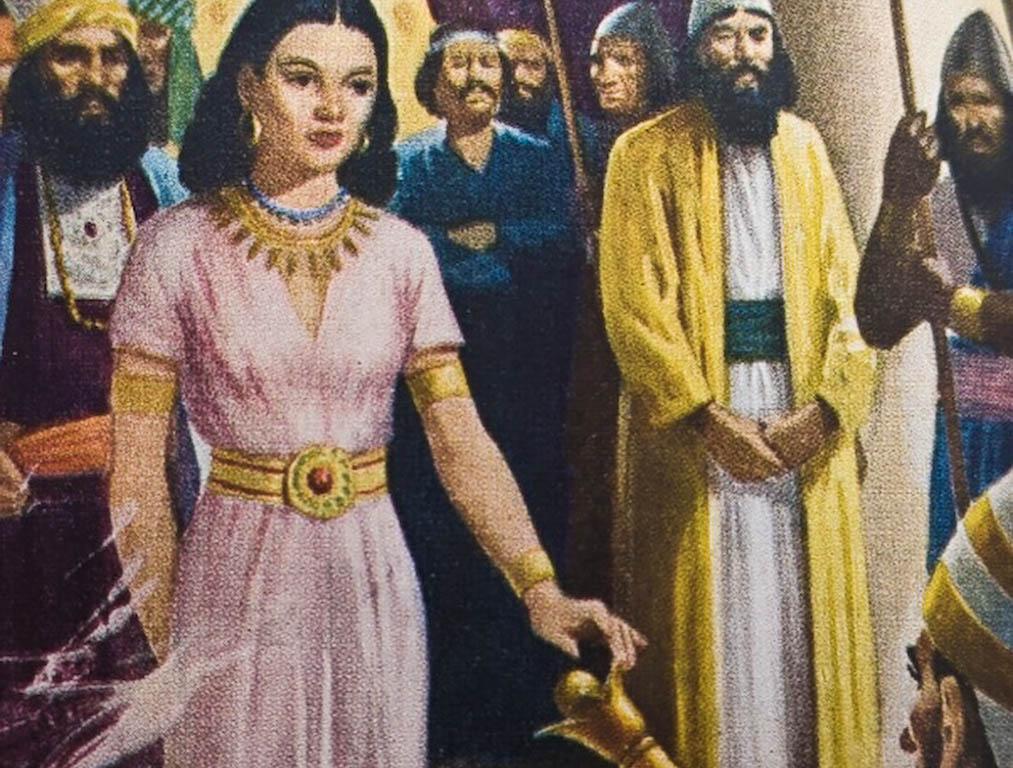 He sent for this slave girl to see what made her so exceptional. She stood before him with a dignity he had never seen in other slaves.
He asked her, ‘Why is your price so high, young woman? [...]
He sent for this slave girl to see what made her so exceptional. She stood before him with a dignity he had never seen in other slaves.
He asked her, ‘Why is your price so high, young woman? [...]  Those are words worth contemplating, on all sides of the political and religious divide today. We live in a time of bitter division. From our government offices down to our kitchen tables there are [...]
  Mentoring, yoga, coaching, self-help texts (now called ‘inspirational books’), mindfulness, meditation, jogging... The proposals for improving our quality of life are so numerous that [...]
  Believing is either hospitable or it is not believing. Hospitality is structurally part of believing. Hosting others in oneself is the very essence of believing in God, not a more or less necessary [...]
  First: Know the 10 Commandments to fail (Donald R. Keough). So, leave these behaviours
Stop taking risks.
Be inflexible.
Seek to isolate yourself.
Convince yourself of being infallible. [...]
First: Know the 10 Commandments to fail (Donald R. Keough). So, leave these behaviours
Stop taking risks.
Be inflexible.
Seek to isolate yourself.
Convince yourself of being infallible. [...]  In traditional societies, the transition from childhood to adulthood was seamless, as young people reproduced the ways of working and living of their elders. And only physical deterioration marked [...]
  Two thousand years ago, Plutarch, historian, philosopher and priest of the temple of Delphi, asked himself: "Why are the temples of the Gods deserted?" In different words, it is the same [...]
 Info
Email: jampypezzi@gmail.com - tel. +39 328 732 6990 / +243 991 457 856
This blog is made in 4 languages: it en fr es

 EDitt | Web Agency
Leave a comment