Justice, Peace, Integrity
of Creation
Justice, Peace, Integrity
of Creation
By John Paul Pezzi, Mccj
Justice, Peace, Integrity
of Creation
By John Paul Pezzi, Mccj
Justice, Peace, Integrity
of Creation
By John Paul Pezzi, Mccj
Justice, Peace, Integrity
of Creation
By John Paul Pezzi, Mccj
Thinking About the Future While the Present Collapses
Comune Info 21.04.2026 Emilia De Rienzo Translated by: Jpic-jp.orgIftar, the meal that breaks the fast during Ramadan, prepared at Casa Acmos in Turin, a place that for more than twenty years has opened its doors to young people wishing to share sobriety in consumption, hospitality, a non-violent approach to conflict, and lifelong learning.

It was in 1942 and 1943 that Simone Weil, in the midst of the tragedy of war and shortly before losing her life, devoted all her energies to envisioning a constituent assembly for Europe. A year earlier, Altiero Spinelli and the other anti-fascists confined on Ventotene had conceived their Manifesto, to which Italian people still continue to look today.
Why return to these examples, familiar though they are? Because in both there is something that now seems to have been lost: the ability to think about the future while the present collapses. Not afterwards, not once everything is over, but within the crisis itself, within the wound of history. It is a lucidity that offers no consolation. It promises no return. Rather, it understands that nothing which comes afterwards can simply amount to a restoration of what once existed.
And yet today, even when signs emerge that appear to fracture balances long regarded as untouchable, the temptation remains to settle for too little. To interpret every change as the possibility of a return to normality. As though it were enough for something to end in order for everything to begin again as before. Perhaps this is the most subtle form of surrender: nostalgia. Entrusting oneself to the past in order to defend against the unease of the present. Imagining that history can be rewound, that democracies can simply be reinstated, that yesterday’s categories are still sufficient for understanding the world. But what Weil and Spinelli had grasped was precisely the opposite: there is no “afterwards” unless it is conceived from within what is actually taking place. One does not emerge unscathed from a historical rupture. One passes through it, and from there attempts to imagine anew.
For this reason, the problem today is not merely political in the narrowest sense of the term. It is more profound: it concerns our inability to detach ourselves from a present that imposes itself as the only possible horizon.
A kind of presentism that suffocates imagination and reduces politics to the management of what already exists.
And yet it is precisely here that a decisive question arises: who is called upon to think — and to build — the future? If we remain trapped within the idea that politics consists solely of what happens within institutions, parties, and leaderships, then the answer will always be delegated. Someone else will have to do it on our behalf. But perhaps this is precisely the limit that must be overcome. Because the future is not born first in programmes, but in practices. It does not take shape solely through official decisions, but through the ways in which we live, work, teach, and build relationships. It becomes visible whenever participation breaks through passivity. Not as a sudden gesture, but as the outcome of slow, often invisible labour.
Even referendums, when they truly happen, do not emerge overnight.
They are the culmination of a fabric of refusals scattered across time and space: countless “noes” taking shape in local communities, in everyday experiences, in local conflicts, in words that circulate and endure. It is there that something begins to move. When what once appeared fragmented finds a point of convergence. When a collection of isolated voices becomes, for a moment, a collective voice. Yet for precisely this reason, a referendum is not an endpoint. It is a passage. Without that widespread groundwork, official politics remains empty. It becomes form without life, language without experience, promise without roots. By contrast, when participatory democratic practices multiply across communities, when people once again exercise shared responsibility, then even what once seemed unthinkable can occur. It is in such moments that a “No King” may emerge — not as a sudden explosion, but as the revelation of something already underway. A refusal built gradually over time, until it becomes visible, until it finds the strength to name itself.
And perhaps it is precisely here that we may return to Weil, to Spinelli, and to María Zambrano. For what unites them is not merely the ability to imagine the future in the midst of crisis, but the way in which such imagination is never separated from life itself. In Weil, it is a radical attentiveness to reality, carried to the point of responsibility. In Spinelli, it is a project born even under the harshest conditions, refusing to abandon the possibility of shaping history. In Zambrano, it is a form of reason that does not confine itself within technique or calculation, but allows itself to be permeated by experience, thereby becoming capable of generating meaning. Three different ways of expressing the same truth: the future is not awaited, delegated, or inherited. It must indeed be thought. But above all, it must begin to be lived. And it always begins here.
The comments from our readers (1)
 Like the one who leaves Paris for the desert and smiles from afar at solitude; like the traveller who awaits with eager heart the long days by the sea; like the monk who lovingly contemplates the [...]
  From the hills of Recanati, on a summer evening in 1819, a remarkable young man, Giacomo Leopardi, reflected on this mystery. How can an obstacle become an opening? How can what limits become [...]
  According to Trapiello, these sects have “wrapped themselves in a kind of ideological packaging,” which is nothing more than “a feeling, an impulse, an intuition. Religions respond [...]
 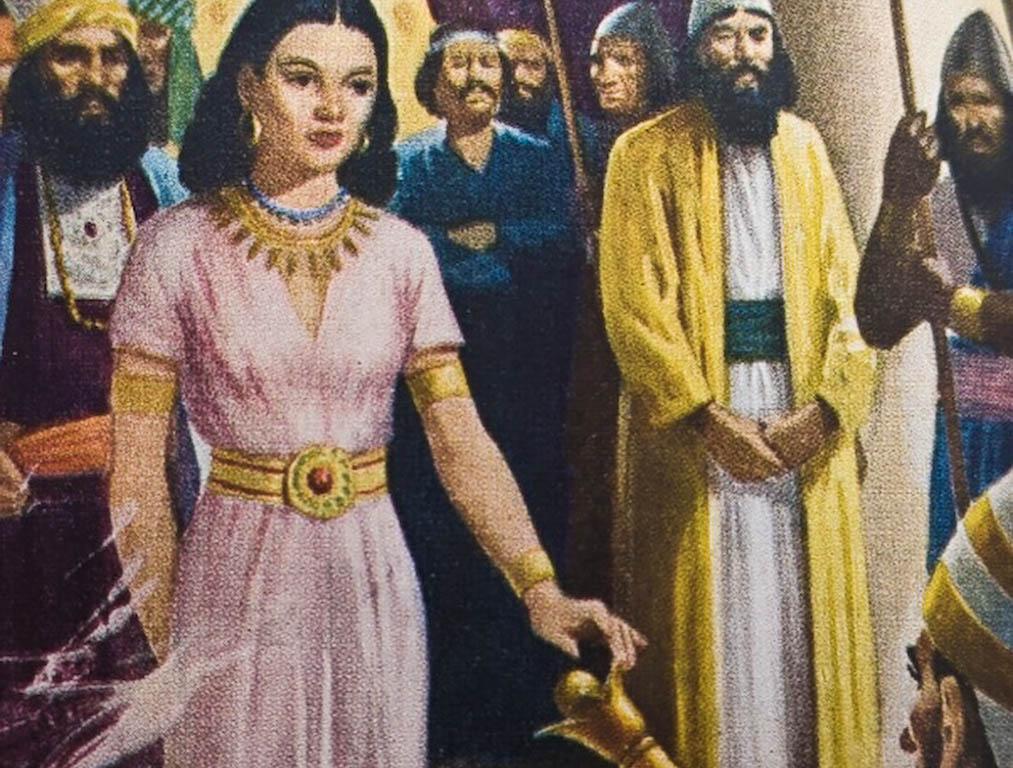 He sent for this slave girl to see what made her so exceptional. She stood before him with a dignity he had never seen in other slaves.
He asked her, ‘Why is your price so high, young woman? [...]
He sent for this slave girl to see what made her so exceptional. She stood before him with a dignity he had never seen in other slaves.
He asked her, ‘Why is your price so high, young woman? [...]  Those are words worth contemplating, on all sides of the political and religious divide today. We live in a time of bitter division. From our government offices down to our kitchen tables there are [...]
  Mentoring, yoga, coaching, self-help texts (now called ‘inspirational books’), mindfulness, meditation, jogging... The proposals for improving our quality of life are so numerous that [...]
  Believing is either hospitable or it is not believing. Hospitality is structurally part of believing. Hosting others in oneself is the very essence of believing in God, not a more or less necessary [...]
  First: Know the 10 Commandments to fail (Donald R. Keough). So, leave these behaviours
Stop taking risks.
Be inflexible.
Seek to isolate yourself.
Convince yourself of being infallible. [...]
First: Know the 10 Commandments to fail (Donald R. Keough). So, leave these behaviours
Stop taking risks.
Be inflexible.
Seek to isolate yourself.
Convince yourself of being infallible. [...]  In traditional societies, the transition from childhood to adulthood was seamless, as young people reproduced the ways of working and living of their elders. And only physical deterioration marked [...]
  Two thousand years ago, Plutarch, historian, philosopher and priest of the temple of Delphi, asked himself: "Why are the temples of the Gods deserted?" In different words, it is the same [...]
 Info
Email: jampypezzi@gmail.com - tel. +39 328 732 6990 / +243 991 457 856
This blog is made in 4 languages: it en fr es


 EDitt | Web Agency
Leave a comment