
Justice, Peace, Integrity
of Creation
Justice, Peace, Integrity
of Creation
By John Paul Pezzi, Mccj

Justice, Peace, Integrity
of Creation
By John Paul Pezzi, Mccj

Justice, Peace, Integrity
of Creation
By John Paul Pezzi, Mccj

Justice, Peace, Integrity
of Creation
By John Paul Pezzi, Mccj
The ‘Voluntary Emigration’ Plan to Empty Gaza
Pagine Esteri 04.09.2026 Michele Giorgio Translated by: Jpic-jp.orgThe far-right minister intends to pursue the project with the next government, aiming to drive around 2 million residents of the Strip out within seven years. “Instead of digging tunnels, it is time for Gazans to pack their bags,” he said.

The idea of emptying Gaza of its population remains on the table in Israeli politics and will form part of the programme of a future far-right government. It has been put forward once again, with determination and in the form of a detailed plan, by Itamar Ben Gvir, the supremacist Minister of National Security and leader of the Otzma Yehudit party. Ben Gvir has made the expulsion of the Strip’s inhabitants one of the main issues of the electoral campaign for the Israeli elections of 27 October.
Ben Gvir has called his plan “Disengagement 710”, a name that simultaneously evokes Israel’s withdrawal from the Gaza Strip in 2005 and 7 October 2023, the Hamas attack in southern Israel. The figures contained in the plan are staggering. Ben Gvir aims to drive around 250,000 Palestinians out of Gaza in the first year, 1.11 million within three years and 1.86 million within seven years. This would therefore amount to the overwhelming majority of the Strip’s population, estimated at more than two million people.
The Israeli right calls all this “voluntary emigration”. A formula that seeks to make a project of ethnic cleansing appear presentable.
Ben Gvir has also outlined an administrative, financial and diplomatic mechanism intended to turn the idea into state policy. “Instead of the illusions of peace, we need action on emigration,” he declared. “Instead of digging tunnels, it is time for Gazans to pack their bags.”
The plan also provides for the creation of a so-called Ministry of Emigration, with its own budget, a team responsible for international negotiations and an operational structure. Otzma Yehudit has already announced that the creation and control of this ministry will be among its main conditions for joining the next government after the elections.
Those who leave Gaza would receive an “integration package” including travel expenses, initial accommodation, vocational training, assistance in finding employment and financial support for up to 24 months. Funding would also be provided to countries that agree to accept Palestinians, in proportion to the number of people they take in. Possible destinations mentioned include Turkey, Ethiopia, Congo and unspecified Arab countries. None of these states, however, appears to have agreed to take in Gaza’s population.
The project comes at an enormous cost. Ben Gvir proposes an initial Israeli investment of 10 billion shekels, approximately 3 billion dollars, followed by a financial mechanism of up to 50 billion shekels, conditional on international participation. A gigantic economic apparatus to make possible what is being described as “voluntary”. Ben Gvir has openly claimed the ideological legacy of Rehavam Ze’evi, the Israeli far-right minister assassinated in 2001 and nicknamed “Gandhi”, who was known for advocating the “transfer”, that is, the expulsion, of the Palestinian population from the West Bank and Gaza. “What a pity they did not listen to Gandhi,” Ben Gvir said. “It is time to admit it: Gandhi was right.”
At the beginning of the week, Defence Minister Israel Katz had argued that the Israeli programme to promote “mass emigration” from Gaza had not been cancelled by Donald Trump, but merely “frozen”. The project had been conceived after, in February 2025, Trump publicly proposed the expulsion of the approximately 2.3 million inhabitants of the Strip, provoking a strong international reaction, including from Egypt. Washington subsequently shelved the idea in the face of the substantial absence of countries willing to accept the Palestinian population.
Donald Trump’s “Riviera of Gaza”
Trump had gone so far as to imagine Gaza being transformed, after the war, into a kind of luxury tourist destination. In his 20-point plan presented in October 2025, however, he distanced himself from the idea of emptying the Strip, promising to “encourage people to stay”. The project, nevertheless, never really disappeared. In June, security officials sought to revive it, including through a new name intended to make it more acceptable internationally. And Katz reiterated that the emigration plan was still “under discussion”.
In the meantime, Gaza has already been transformed into an immense territory of displaced people. The devastating Israeli offensive – which has killed more than 73,000 Palestinians – has forced the overwhelming majority of the population to abandon their homes. More than 60 per cent of the Strip is now under Israeli military occupation, and reconstruction has never begun because Israel wants Hamas to be completely disarmed before allowing it to proceed. On 30 July, the Islamic movement accepted the disarmament plan of the Board of Peace for Gaza (BOP), which emerged from the Trump plan, but Israel argues that the proposal would not guarantee the end of Hamas’s military capabilities and has therefore rejected the gradual withdrawal provided for under the agreement.
Before the UN Security Council, the BOP envoy, Nickolay Mladenov, criticised Israeli restrictions on the provision of housing to the Palestinian population, highlighting the catastrophic conditions in which the inhabitants of the Strip are living. He also stated that the continuation of Israeli attacks had not and would not lead to the disarmament of Hamas, while also criticising the Palestinian movement for failing to honour the commitments it had undertaken.
Ben Gvir’s plan has little chance of being implemented in the form announced. It would require countries willing to accept hundreds of thousands, and eventually millions, of Palestinians; enormous financial resources and, above all, an international political consensus that does not exist today. But it would be a mistake simply to dismiss it as an electoral fantasy. The idea of emptying Gaza of its population has become a formalised proposal, organised into twelve points and intended, in Ben Gvir’s view, to become a cornerstone of the formation of the next Israeli government.
See: Ben Gvir presenta il piano di “emigrazione volontaria” per espellere i palestinesi da Gaza
Photo. Donald Trump’s ‘Riviera of Gaza
 “Follow the money,” the investigators in the series The Wire used to say, drawing inspiration from the plot of All the President’s Men. Follow the trail of money and you will reach [...]
 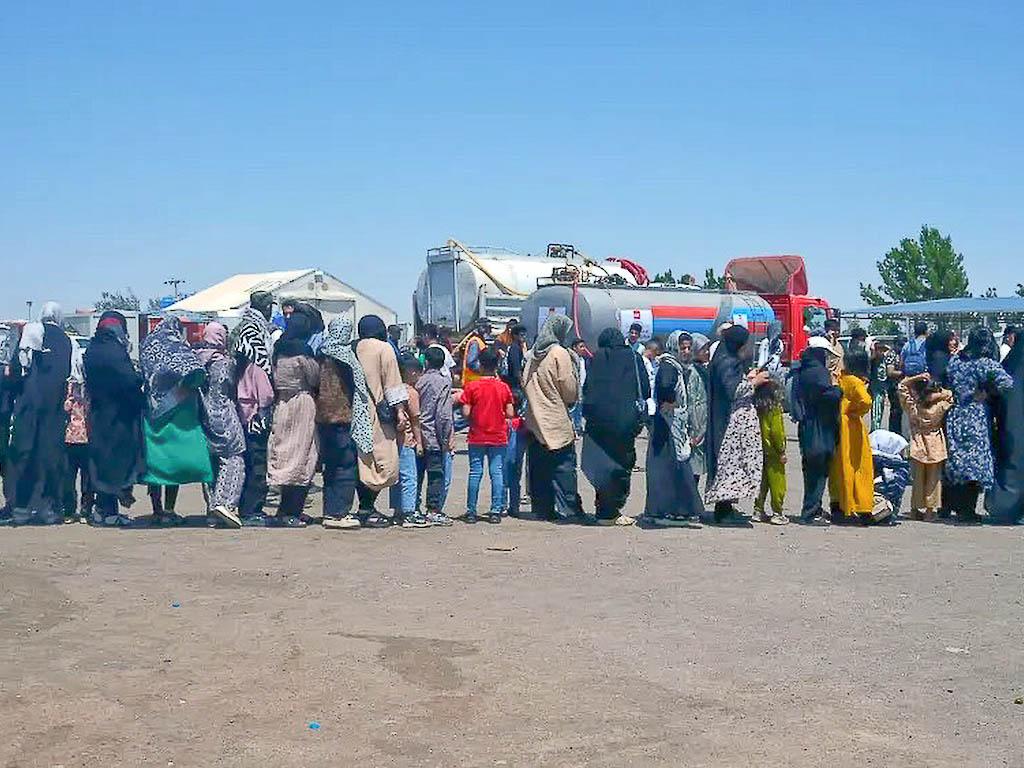 Afghan expulsions are ramping up in Iran. Over 256,000 Afghans have been deported since early June, and according to the International Organization for Migration (IOM), on June 25 alone, more than [...]
  More than a third of Africans want to move permanently to live elsewhere, according to a study by the US-based analysis and consulting company Gallup based on a 2023 survey. A result that marks a new [...]
  When it is said that we do not do enough for immigrants, it is always talking about governments and people of the countries of arrival. But when immigrants become “hostages” of [...]
  Not even this extreme situation has been able to put doors on the sea, to contain those who fight with the only thing they have, with their skin, hand to hand against the sea. The sea that fed them, [...]
 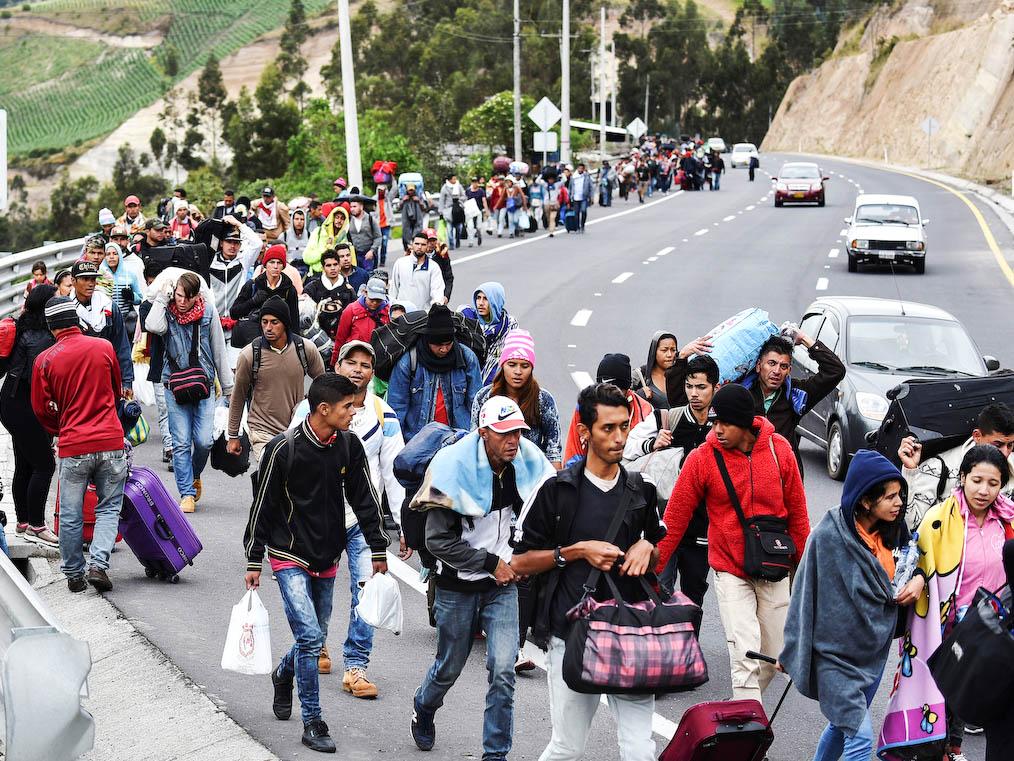 According to the Response for Venezuelans, which is a joint International Organization for Migration and UNHCR platform, the total number of migrants leaving Venezuela reached about 4.6 [...]
  “Migration must be a voluntary act, and not a forced act. Poverty, hunger, climate change, insecurity - that is, severe underdevelopment - create a perfect storm in which thousands of people [...]
  Pope Francis during the SFMM (Social Forum on Migrations - Mexico November 2018), sent a clear message: the refugees and the migrants are persons and no one has the right to think for them, judge [...]
  The high-level meeting was marked from the start by an unprecedented event: the absence of at least seven member states that canceled their participation almost at the last minute. The international [...]
  Having experienced detention first-hand, 26-year-old Sallah set up, Youths Against Irregular Migration, (YAIM) using the airwaves in his home country, as well as social media and road shows, to try [...]
 Info
Email: jampypezzi@gmail.com - tel. +39 328 732 6990 / +243 991 457 856
This blog is made in 4 languages: it en fr es





 EDitt | Web Agency
Leave a comment