Justice, Peace, Integrity
of Creation
Justice, Peace, Integrity
of Creation
By John Paul Pezzi, Mccj
Justice, Peace, Integrity
of Creation
By John Paul Pezzi, Mccj
Justice, Peace, Integrity
of Creation
By John Paul Pezzi, Mccj
Justice, Peace, Integrity
of Creation
By John Paul Pezzi, Mccj
African borders existed before colonisation
Radio France 06.01.2026 Camille Lefebvre Translated by: Jpic-jp.orgIt is often said that African borders are artificial because they were drawn by colonisers. Yet all borders in the world are artificial. Borders are artefacts, human constructions.
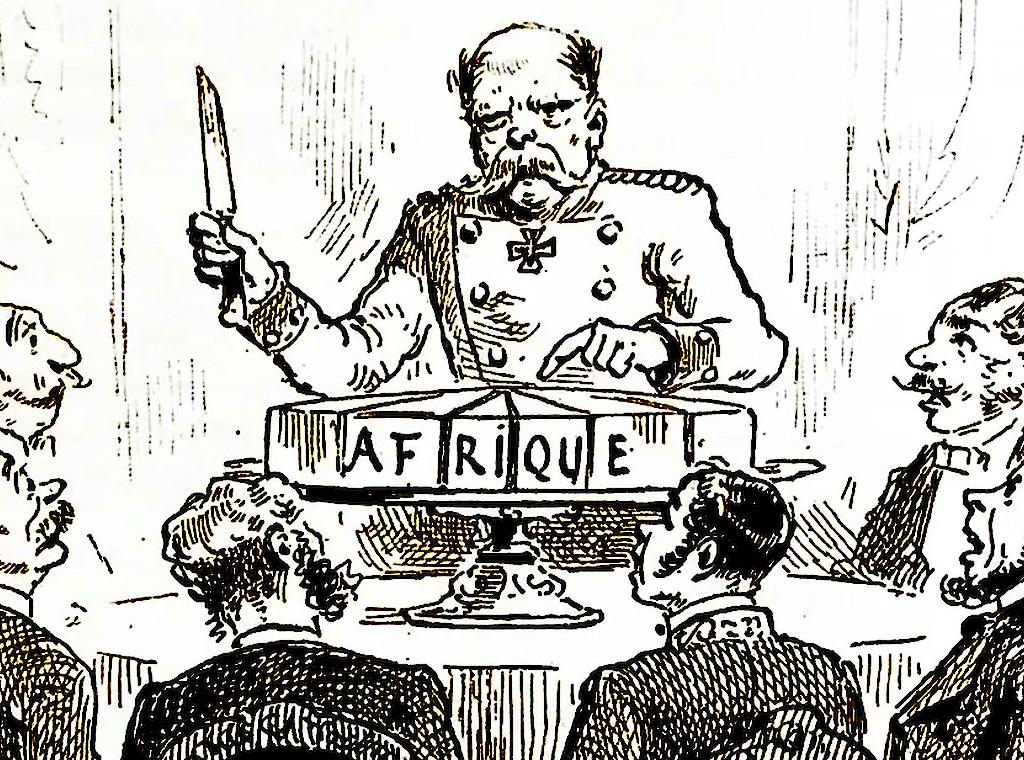
Borders are always imposed by political powers from the centre upon distant regions. The idea that African borders are solely the result of colonisation is, moreover, itself a colonial idea.
The partition of Africa, a representation of a colonial construction
In 1884, the Berlin Conference took place with the aim of regulating future colonial settlements on the African continent. On the margins of this conference, Europeans and Ottomans produce narratives portraying imperial powers dividing up the continent among themselves. Engravings, books and maps are published in French, English, Spanish and Turkish, in which commentators dwell on the “African cake” supposedly being shared.
On the continent itself, reality is quite different: colonial occupation is not completed and, in some cases, has not even begun. This narrative of the partition of Africa belongs to colonial propaganda and enables Europeans and Ottomans to assert their superiority by constructing the idea of an African continent devoid of political power.
Borders drawn before colonisation
Yet when French, British and other colonisers arrive in Africa at the end of the nineteenth century and draw borders there, contrary to their claims, they do not enter an empty space, a no man’s land or an undifferentiated anarchy. On the ground, they encounter rulers and often states. They use routes and cross borders that already exist.
Let us take an example: the border between Niger and Algeria, a straight line often cited to demonstrate the artificiality of African borders. Long before France’s colonisation of the Sahara at the beginning of the twentieth century, this area was a stop on the trans-Saharan caravan routes between Tripoli and Kano, linking what are now Libya and Nigeria.
This long-distance caravan trade was subject to strict rules, and the safety of people and goods was guaranteed by political authorities. Far from the stereotypical image of a borderless desert, there existed a boundary between two Tuareg rulers: The Sultan of Aïr and the amenokal of the Kel Ahaggar.
To enter the territory of the Sultan of Aïr, caravans and travellers first had to stop at Assamaka and send a letter written in Arabic, the language of the region’s chanceries, in order to obtain permission to continue their journey.
Once authorised to proceed, caravans had to stop again at Iferouane, where the Sultan of Aïr’s representative levied a tax on goods, known as fito. Failure to comply with these rules of travel rendered one’s stay illegal and therefore unprotected by political authorities. Travellers were then left at the mercy of bandits.
When French colonisers sought to draw a border in this region, they took the key points of this earlier boundary and connected them with a line, thereby reproducing the existing border.
The key role of African societies
African societies and their states, through their history, through negotiations or through resistance, played a decisive role in shaping the continent’s borders. To continue perpetuating the idea that African borders are merely scars of colonisation ultimately means repeating the discourse of colonial propaganda, which denied African societies their capacity to act.
See, Les frontières africaines existaient avant la colonisation
Photo. Caricature of the Berlin Conference of 1885. © Creative Commons.
The comments from our readers (3)
 Africa pays an extraordinarily high price for negative stereotypes. According to the 2024 report The Cost of Media Stereotypes to Africa, by Africa No Filter and Africa Practice, the continent loses [...]
  Brics or the Shanghai Cooperation Organisation? This is the question many observers are asking when considering Africa’s future, following the parade in Beijing last September. Within the [...]
  Soumaila Diawara, originally from Mali, is a writer, political activist, and refugee. Raised in Bamako, he became involved in student movements advocating democratic opposition. After the military [...]
  The book (Infinito Edizioni, 2024, pp. 101, € 14.00) by journalist Enzo Nucci, who for sixteen years was RAI's (Italian Radio & TV broadcasting) correspondent from Nairobi, is entitled [...]
  They resent political leaders deemed “corrupt,” “incompetent,” “in the pay of the West” (accused of imperialism and neo-colonialism). We have seen them parading in [...]
  The year 2023 on the African continent has seen the opening of many global construction agendas that deserve attention and much implementation work. There are at least three international events that [...]
  The complexity of Africa is rendered perhaps by the number of its languages: someone will have counted them. In Zimbabwe alone there are 16 official ones, while in South Africa there are 11. In this [...]
  All of this was blown to bits when Hamas launched an attack on Israeli territory from the Gaza Strip on 7th October 2023. The images were truly chilling, both for the number of deaths and the cruelty [...]
  The book King Leopold’s Ghost, by Adam Hochschild, is a book relating through its more than 360 pages “A story of greed, terror, and heroism in colonial Africa.” In fact, “It [...]
  How is the African economy doing? According to the World Bank's latest Africa's Pulse report, the continent is experiencing a diverse situation. Global inflationary pressures, the threat of [...]
 Info
Email: jampypezzi@gmail.com - tel. +39 328 732 6990 / +243 991 457 856
This blog is made in 4 languages: it en fr es

 EDitt | Web Agency
Leave a comment