Justice, Peace, Integrity
of Creation
Justice, Peace, Integrity
of Creation
By John Paul Pezzi, Mccj

Justice, Peace, Integrity
of Creation
By John Paul Pezzi, Mccj
Justice, Peace, Integrity
of Creation
By John Paul Pezzi, Mccj

Justice, Peace, Integrity
of Creation
By John Paul Pezzi, Mccj
Banks and authoritarian regimes: when finance supports repression
http://www.valori.it 10.12.2025 Alessandra Tommasi Translated by: Jpic-jp.orgHow banks and global finance support authoritarian regimes through bonds, ETFs and financial instruments, fuelling repression and human rights violations
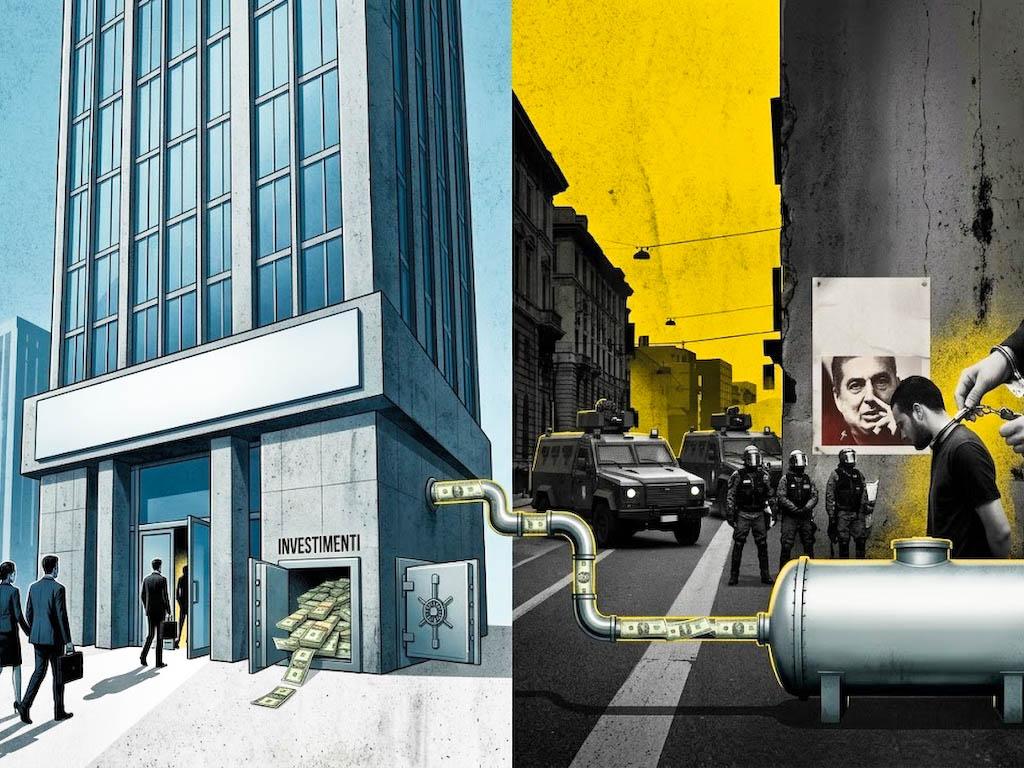
Global finance is not a neutral mechanism. Through loans, investments, index funds and speculative instruments, it can support repressive regimes, fuel conflicts, promote destructive production models or weaken fundamental rights throughout entire supply chains. Analysing these mechanisms means showing how, behind apparently technical choices, there are concrete impacts on people’s lives: from repression by authoritarian regimes to violence at borders, from textile supply chains to speculation on food, and even major sporting events.
It is worth remembering that this money is not abstract: it is ours. It is the savings, pension funds and current accounts of millions of people. And it is also through our choices – whom we entrust with our money, which operators we reward or abandon – that we can help build a fairer financial system.
In October 2025, a landmark ruling recognised the role of BNP Paribas in crimes committed by Omar al-Bashir’s regime in Sudan in the 1990s and early 2000s. According to a Manhattan federal jury, France’s largest bank had facilitated the genocide perpetrated during those years by providing financial services that violated US sanctions, thereby enabling the government in Khartoum at the time to arm its campaigns of violence.
The verdict, although the outcome of a first-instance civil trial and pending appeal, is among the first to establish a causal link between the activities of a global bank and crimes against humanity. It also puts the spotlight once again on how finance can, directly or indirectly, support authoritarian regimes and fuel rights violations and even wars, including where sanctions are in place. From payment and trade-finance guarantee systems – such as letters of credit in the Sudanese case – to the issuance of government bonds on global markets, the mechanisms used are diverse.
The Sudan–BNP Paribas case: when banks circumvent sanctions
The Sudanese case shows how financial engineering can circumvent sanctions imposed on regimes. As early as 2014, BNP Paribas Geneva, the subsidiary at the centre of the case, admitted that it had knowingly violated them by transferring more than $6 billion into the US financial system on behalf of Sudanese entities, through a network of “satellite banks”. The key instrument was letters of credit, which guarantee transactions in international trade and which BNP Paribas issued in dollars, removing any reference to sanctioned entities. In 2006, the value of these letters amounted to around a quarter of Sudan’s exports and a fifth of its imports; during those same years, the repressive machinery of pro-government troops was estimated to have caused 300,000 deaths in Darfur alone.
The multibillion-dollar fine paid to US authorities in 2014 never reached the victims of the conflict. The ruling last October – around $20 million in favour of three plaintiffs – could, however, pave the way for a class action by more than 20,000 Sudanese refugees in the United States.
Sovereign bonds and human rights: the legal complicity of global finance
While regimes also operate within global finance through alternative international financial institutions – often regional development banks, the OPEC Fund, but also the New Development Bank of the BRICS countries – the issuance of government bonds remains one of the main instruments, with the legal complicity of major banks and investment funds. The market logic is simple: if a country is not under sanctions and is considered reliable, its debt is attractive. This is also because financial fund screening systems rarely include human rights criteria. The same European obligations concerning sustainable finance – the “ESG”, covering environmental, social and governance issues – apply to investors and companies, not governments.
There is also a less visible mechanism: unfiltered Exchange-traded funds (ETFs), meaning those that automatically replicate global indices and purchase the securities included in benchmarks, without assessing the political context of the issuers. This mechanism is particularly relevant for countries such as Egypt and Saudi Arabia – now among the leading countries in emerging-market indices – whose bonds therefore enter directly into the portfolios of millions of European and US savers.
Egypt and Saudi Arabia: a bond boom despite torture and repression
Last October, Abdel Fattah al-Sisi’s Egypt issued sovereign sukuk – bonds compliant with Islamic law – worth $1.5 billion, as part of a broader initiative expected to reach $4 billion. Egypt’s Finance Ministry said that investor demand had exceeded $9 billion. The issue was organised by giants such as HSBC and Citibank, together with Gulf banks including Dubai Islamic Bank, First Abu Dhabi Bank and Abu Dhabi Islamic Bank.
Yet Egypt, which remains one of the harshest regimes in the MENA region (the English acronym for Middle East and North Africa), has over the years issued bonds worth billions which, once included in international indices, have been automatically purchased by ETFs (the English acronym for Exchange Traded Fund) and index funds. At the same time, human rights organisations documented an increase in torture, arbitrary detentions (as in the case of activist Patrick Zaki) and enforced disappearances caused by a regime that, among other things, was responsible for the murder of Giulio Regeni.
Saudi Arabia, meanwhile, sold dollar- and euro-denominated bonds worth almost $20 billion in 2025 alone. For the latest sukuk tranche ($5.5 billion), investors placed orders worth around $19 billion, confirming the strength of demand, with Citigroup, HSBC, JP Morgan and Standard Chartered acting as coordinators and bookrunners. Since 2016, with the launch of the Vision 2030 development programme, Saudi Arabia has regularly issued sukuk and bonds. Those same years have been marked by the murder of journalist Jamal Khashoggi (attributed to Crown Prince Mohammed bin Salman), the military campaign in Yemen, repression of dissidents and hundreds of executions.
Blood bonds and hunger bonds: Belarus and Venezuela in Western portfolios
The Belarusian “blood bonds” became famous in recent history. These were $1.25 billion in bonds issued by Alexander Lukashenko’s government just weeks before the disputed 2020 presidential election and the brutal repression of the protests. There were also the “hunger bonds” issued by Venezuela’s national oil company in 2017 and purchased on the secondary market mainly by Goldman Sachs for $2.8 billion, at the height of the humanitarian crisis under Nicolás Maduro.
Record ESG funds, but finance continues to support wars and repression
Today, however, in a context in which global ESG funds have reached a record level of $11.9 trillion in the second quarter of 2025, up 21% year on year, the contradiction is even more evident. Global finance cannot continue to operate as a mechanism that fuels wars, repression and human rights violations. This is particularly so because many financial actors declare that they adhere to the Principles for Responsible Investment (PRI) and the United Nations Global Compact. Their respective countries have also often signed up to the OECD guidelines on due diligence, which recall that financial institutions can “cause or contribute” to adverse impacts on human rights even through the simple underwriting of bonds that make those impacts possible.
Israeli war bonds: war debts reaching global markets
One case that shows the scale of this contradiction, even beyond authoritarian regimes, is that of Israeli “war bonds”. Between October 2023 and January 2025, Israel raised more than $19 billion through bonds, some of which were intended to finance the war in Gaza.
An investigation by the Dutch research centre Profundo reconstructed how seven major Western investment banks played a decisive role in placing these securities on the global market. Goldman Sachs, Deutsche Bank, Bank of America, BNP Paribas, Citigroup, Barclays and JPMorgan Chase acted as underwriters, guaranteeing the sale of sovereign bonds and ensuring continuous liquidity for Tel Aviv as allegations of serious violations of international and humanitarian law increased, to the point that the term “genocide economy” began to be used.
See, Banks and authoritarian regimes: when finance supports repression
This article is part of an Italian dossier containing other articles, for example:
Banks, the environment and human rights: the dark side of the green transition
When finance fuels abuses in migration
Finance and food: when speculation fuels hunger
The comments from our readers (2)
 Approximately two hundred euros, at purchasing power parity: this is what, on average, is spent on the education of a child in Sub-Saharan Africa every twelve months. In Europe, the figure is around [...]
  Right and left presupposed a common space: constitutional democracy, the rule of law, and the mutual recognition of political actors as legitimate opponents. The current crisis, by contrast, operates [...]
  Did you know that Saudi Arabia and the United Arab Emirates, despite their deserts, import millions of tonnes of sand every year? Why do they rely on imported sand for their mega-projects? [...]
  In a report presented on 19th January 2026 at the opening of the World Economic Forum in Davos, the British organisation Oxfam reported that global billionaires’ fortunes increased by 16% in [...]
  Economic growth is not a statistical abstraction; it is the most powerful lever humanity has ever known for the tangible improvement of well-being. Over recent decades, its impact has been [...]
  Undoubtedly, there has never been an era of true free trade. International trade has always been only partially and unevenly free and, in most cases, regulated. Most so-called neoliberal advocates [...]
  In an age marked by individualism, social fragmentation, and a crisis of human bonds, rediscovering the value of the common good is not just a cultural exercise, but an ethical and political [...]
  Liberalism is a doctrine that does not claim to have answers for everything, unlike Marxism, and welcomes divergence and criticism within its framework, based on a small but unmistakable core of [...]
  Despite the apparent variety of brands on supermarket shelves, much of the food and drink we consume every day is controlled by a small group of large multinationals. According to an analysis made [...]
  In your most recent book, Power and Progress, you mention that we are at a critical moment regarding the relationship between technology, equality and democracy. What consequences do you foresee if [...]
 Info
Email: jampypezzi@gmail.com - tel. +39 328 732 6990 / +243 991 457 856
This blog is made in 4 languages: it en fr es



 EDitt | Web Agency
Leave a comment